 UGTKengine within an engine
UGTK / Toolkit / Utility Systems / Graph System Completed

Graph System
Summary
The Graph System is a generic, serializable graph data structure (Graph<T>) built from
Node<T> and weighted Edge<T>. It offers traversal (BFS / DFS) and pathfinding
(Dijkstra and A*), plus grid/strategy helpers like reachable-within-cost and farthest-nodes.
Content
Modules Dependencies
This module has no hard UGTK dependencies (pure C# data structure).
Setup
No scene setup, no component, no prefab: it is a plain C# data structure, so there is nothing to
show in a GIF. Instantiate Graph<T> from code and populate it with nodes and edges.
The classes live in the global namespace (
Graph<T>,Node<T>,Edge<T>), so nousingis needed — but those are very common names: watch out for collisions with other packages.
How To Use
var graph = new Graph<string>();
graph.AddNode("A");
graph.AddNode("B");
graph.AddNode("C");
graph.AddEdge("A", "B", 1);
graph.AddEdge("B", "C", 5);

graph.Bfs("A");                                  // logs the BFS order
graph.DFS("A");                                  // logs the DFS order

List<Node<string>> path = graph.FindShortestPathByDijkstra("A", "C");
List<Node<string>> aStar = graph.AStar("A", "C"); // uses HeuristicCostEstimate (override for a real heuristic)

var reachable = graph.GetReachableNodesWithinCost(graph.GetNodeContainsValue("A"), 3);
For A, subclass Graph<T> and override HeuristicCostEstimate(node1, node2) to provide a real
heuristic (the base returns 0, making A behave like Dijkstra). Nodes can be marked non-traversable
via Node<T> (BecomeUntraversable() / BecomeTraversable() / IsTraversable()), which A*,
reachable and farthest queries respect.
Good to know:
BfsandDFSonly log. They walk the graph andDebug.Logthe order — they return nothing. They are inspection tools, not building blocks: for real traversal use the pathfinding methods or write your own walk overGetNodeList().- Out of the box A* == Dijkstra, because the base heuristic returns 0. Overriding
HeuristicCostEstimateis not optional if you want the speed-up: on a grid, Manhattan or Euclidean distance between the two node values is the usual choice. - Edges are weighted with
int. No fractional costs: scale your costs (×10, ×100) if you need decimals. Dijkstraignores traversability, whileAStar,GetReachableNodesWithinCostandGetFarthestNodesrespect it. If you use non-traversable nodes as walls, use A*, not Dijkstra.- Nodes are matched by value. The
T-based overloads look the node up by its value, soTmust have sensible equality (astruct, astring, or a class that overridesEquals), and values must be unique. - The structure is undirected:
AddEdge(a, b, w)connects both ways.
Testing Scene
Open Debug/GraphSystemScene.unity. It holds one object, GraphSystemTest, carrying
Mn_GraphSystemTest. Everything happens in the Inspector: right-click the component header and
the seven entries of its context menu appear. No play mode, no wiring.
What to do, in order:
- Build Grid — a 5×5 grid of nodes named
"x,y", wired to their four neighbours with weight 1. Twenty-five nodes, forty edges. - Find Path Dijkstra and Find Path AStar — both return nine nodes for a cost of 8. On a uniform grid the two agree; A* gets there having visited fewer nodes, which is the whole point of the heuristic.
- Find Reachable — every node within Movement Budget steps. With a budget of 3 that is ten nodes, and it is the call a tactics game uses to paint the movement range.
- Block Node — closes the node named in Node To Block,
2,0by default, which sits on the straight path. - Find Path AStar again — the route now goes
0,0 → 1,0 → 1,1 → 2,1 → 3,1 → 4,1 → …, around the closed node, at the same cost of 8. Blocking changes the shape of the graph without rebuilding it. - Unblock Node puts it back.
Two things worth knowing, both visible here. Traversability is a property of the node, not of the edges, so closing a door costs one call and no rebuild. And the search does not check the start node: block the node you are standing on and the path still comes back, because the algorithm starts from it rather than entering it.
Technical Info
- Graph\<T>: the graph container — add/remove nodes & edges, search, BFS/DFS, Dijkstra, A*, and utility queries (
GetReachableNodesWithinCost,GetFarthestNodes,GetNodeList). - Node\<T>: a graph node holding a value, its edges and a traversable flag.
- Edge\<T>: a weighted connection between two nodes.
© 2026 Marcello De Bonis. All rights reserved
More in Utility Systems.
all 34 →
RandomicListElements System
The Randomic List Element System manages lists where each element has a unique percentage, ensuring totals equal 100%, with support for locking, syncing, and random selection.
Completed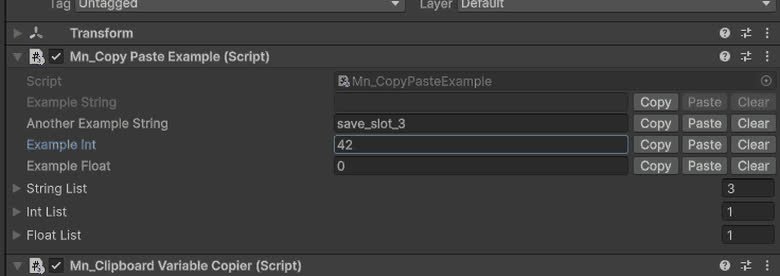
Copy Paste System
The Copy Paste System enhances Unity's Inspector with Copy, Paste, and Clear buttons for efficient string manipulation.
Completed
Image Picker
Component that allow in a WebGL build to get an image from user computer
Completed
Time Online System
TimeOnlineSystem is a system that allows you to get the time from a server.
Completed